
Dubai Robot-Ready Buildings: What Indoor Deliveries Mean for Smart Property Automation
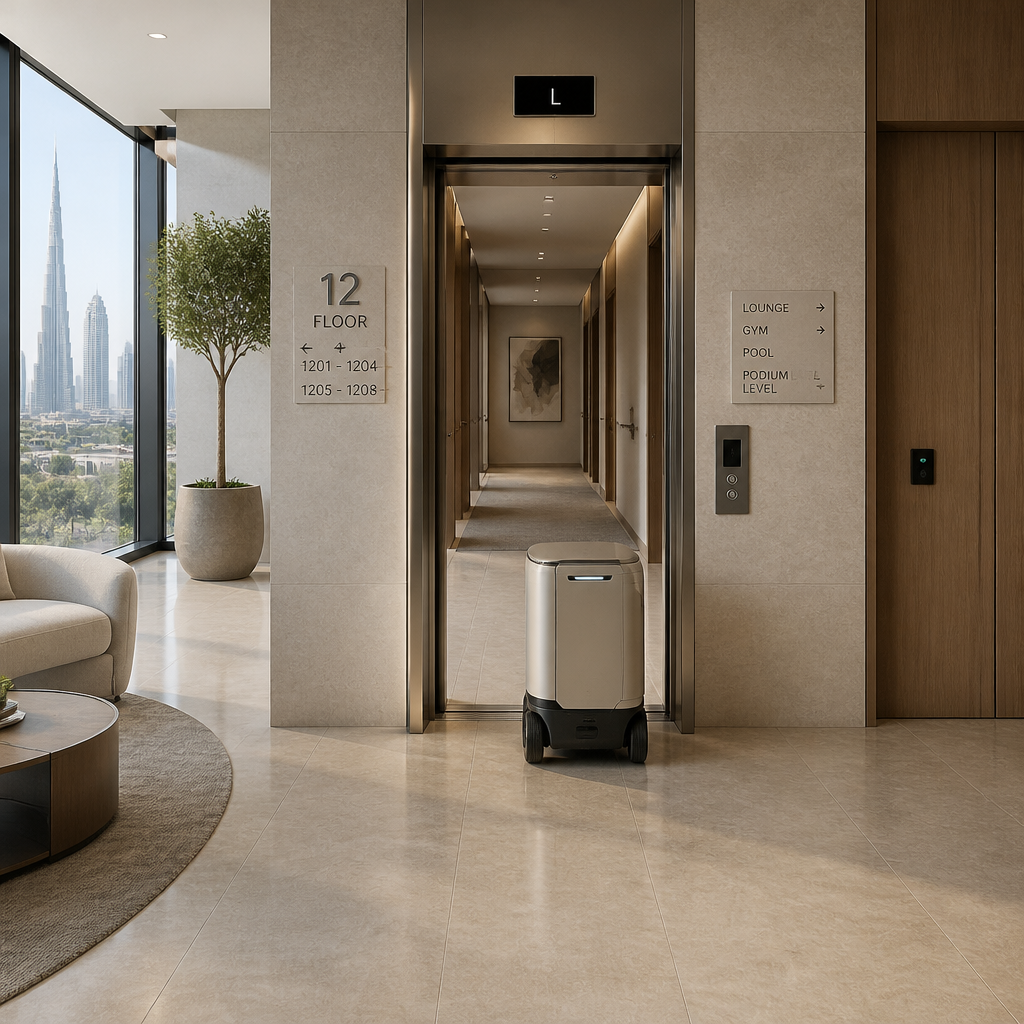
For developers exploring Dubai robot-ready smart buildings, the useful starting point is a delivery journey, not a robot purchase. Decide where a machine may enter, who authorises its movement, how it reaches the recipient and what happens when something fails. Treat readiness as a coordinated design and operating brief rather than a label attached to a property.
What has Dubai announced?
Emirates News Agency reports that Dubai Future Labs launched the Robots Indoor Logistics Program with logistics partners, with a first-phase aim of making 100 buildings robot-ready by 2029. That is a programme target, not evidence that those buildings are already operational. See the WAM announcement.
The Dubai Future Foundation’s delivery-robot initiative page provides separate background on robotic last-mile delivery and a Meadows community pilot. It should be read as context, not independent confirmation of the building target.
For a development team, the useful response is to turn this direction into questions for design coordination. Which journeys would you permit? Which systems would need to cooperate? What evidence would justify expanding a trial? This article’s recommendations are an editorial planning framework, not an official definition of robot readiness or a certification checklist.
Define the delivery service before specifying the technology
Begin with the service boundary. A robot that hands a parcel to reception presents a different design brief from one expected to reach a residential floor. Avoid describing both arrangements simply as automated delivery.
Write a journey covering arrival, identity check, entry approval, waiting, vertical travel, handover and exit. At each step, name the person or system allowed to authorise the next movement. Also define the point at which an unsuccessful delivery returns to a human operator.
Ask residents’ representatives and facilities staff to review the proposed journey before procurement. Would a resident prefer reception collection? Who assists someone unable to retrieve a parcel immediately? Where should a robot wait without occupying a shared route?
Keep these questions connected to the wider living experience. The smart living topic area and Dubai smart-home overview are related internal reading paths, but neither should substitute for a project-specific delivery brief.
Treat building access as a controlled permission
For building access control robotics, specify the permission model before discussing an integration interface. Ask suppliers to explain how the building will distinguish an authorised delivery mission from a device merely requesting entry.
A useful brief should require an identifiable mission, an approved destination and a defined expiry condition. Ask whether access can be limited to the relevant entrance and route, and how staff can revoke it. Do not assume that permission to enter a lobby should also permit access to every residential floor.
Require a demonstration of rejected requests as well as successful ones. Test an expired mission, an incorrect destination and a disconnected service. Agree the response with the security team rather than leaving it to a supplier’s default behaviour.
For interoperability discussions, use the open smart-home ecosystem overview as a related starting point. Keep the robot interface specification separate: document exactly which commands, permissions and status messages the proposed building connection would expose.
Coordinate lifts, doors and recovery procedures
Draw the proposed route on the building plan. Mark thresholds, waiting positions, door transitions, lift lobbies and the destination. Then ask each responsible contractor to identify the interfaces that require assessment or approval.
For lifts, request a joint review with the lift supplier and building operations team. Establish how a journey request would be accepted, how arrival would be confirmed and what should happen if the intended car is unavailable. Avoid accepting a generic claim of compatibility without a witnessed demonstration against the proposed configuration.
Write a recovery procedure for each interrupted transition. If a door does not open, should the robot wait, retreat or request help? Who receives that request? How can staff safely remove a stopped device from the planned route?
Keep emergency behaviour within the building’s authorised safety review. Do not let a delivery workflow independently override emergency controls. Treat unresolved safety questions as reasons to pause the proposed route, not details to finish after launch.
A practical Dubai residential-tower example
Consider a hypothetical Dubai apartment tower assessing indoor delivery. The developer could begin with reception handover while evaluating a separate route to a designated collection area. This is a proposed planning example, not a report of an operating property.
In the trial brief, reception confirms the delivery mission before entry. The robot moves only along the agreed route and waits at a marked collection point. The resident receives a notification through the selected communication channel. If collection does not happen within the agreed service window, reception follows the documented recovery process.
Before adding residential-floor destinations, ask the team to demonstrate access rejection, lift unavailability, resident cancellation and loss of connectivity. Include a receptionist and facilities supervisor in the exercise. Their ability to understand and resolve an interruption should matter as much as the robot completing its normal journey.
Define success through observable acceptance criteria: correct destination handling, clear notifications, no unauthorised access and a workable staff response.
Make data ownership and handover explicit
Ask bidders to list the information required for each delivery step. Separate mission status from resident identity, destination details and any proposed image capture. For each category, request a documented purpose, access policy, retention proposal and deletion process, subject to the project’s legal review.
Assign ownership for incident records and support tickets. If a resident reports a failed delivery, who investigates, and which parties may inspect the relevant record? Specify how an operator change or contract termination would affect access credentials and retained information.
Include staff training in the handover brief. A short operating guide should explain normal operation, manual intervention, escalation and suspension of service. The academy is a related internal learning destination; project training should still be tailored to the actual equipment and approved procedures.
What developers should request next
Ask for a coordinated readiness pack rather than a presentation of isolated features. Include the route drawing, interface responsibilities, access policy, data-handling proposal, test plan and operational handover requirements.
Separate demonstrated capabilities from options requiring further engineering. Record dependencies on the access-control contractor, lift supplier, delivery operator and facilities team. Give every unresolved item an owner and an acceptance condition.
For smart building automation UAE projects, make expansion a decision gate: approve additional destinations only after reviewing trial evidence and staff feedback. Keep the wider briefing material in your project library alongside relevant resources, but base acceptance on witnessed tests and agreed documentation, not promotional language.
Treat robotic delivery in Dubai buildings as a shared design and operations responsibility. Define the journey, constrain permissions and test interruptions before extending access. A useful readiness brief should tell residents, staff and suppliers exactly what the service may do—and who takes over when it cannot.
Expert answers
Frequently asked questions about this article
Explore practical answers before selecting the right technology. Smart Citizens designs and proposes each solution around your actual property or business requirements.
- 01Tell us about your site and objectives.
- 02We assess systems and integrations.
- 03Receive a defined scope and project proposal.
Pricing, schedules and integrations are subject to each project's technical and commercial assessment.
Frequently asked questions
Practical answers for your next decision
Open any question to explore the details.
01Should a trial start with deliveries to apartment doors?
Not necessarily. Consider a reception or shared-collection route first, then assess whether residential-floor access is justified by the trial evidence and operating requirements.
02What should developers ask a robot supplier to demonstrate?
Request both successful journeys and controlled failures, including rejected access, an unavailable lift, cancellation and connectivity loss. Require clear staff recovery procedures.
Explore next
Get a tailored Smart Citizens proposal
Tell us about your villa, apartment or project — our AI Advisor recommends the right package within minutes, or book a free site visit with our Dubai team.
Prices and recommendations may vary based on villa size, wiring, system type, and customer requirements.
Share this guide with someone planning a smart home in Dubai.