
DEWA Savings from Smart Homes: What Should Government Buyers Verify?
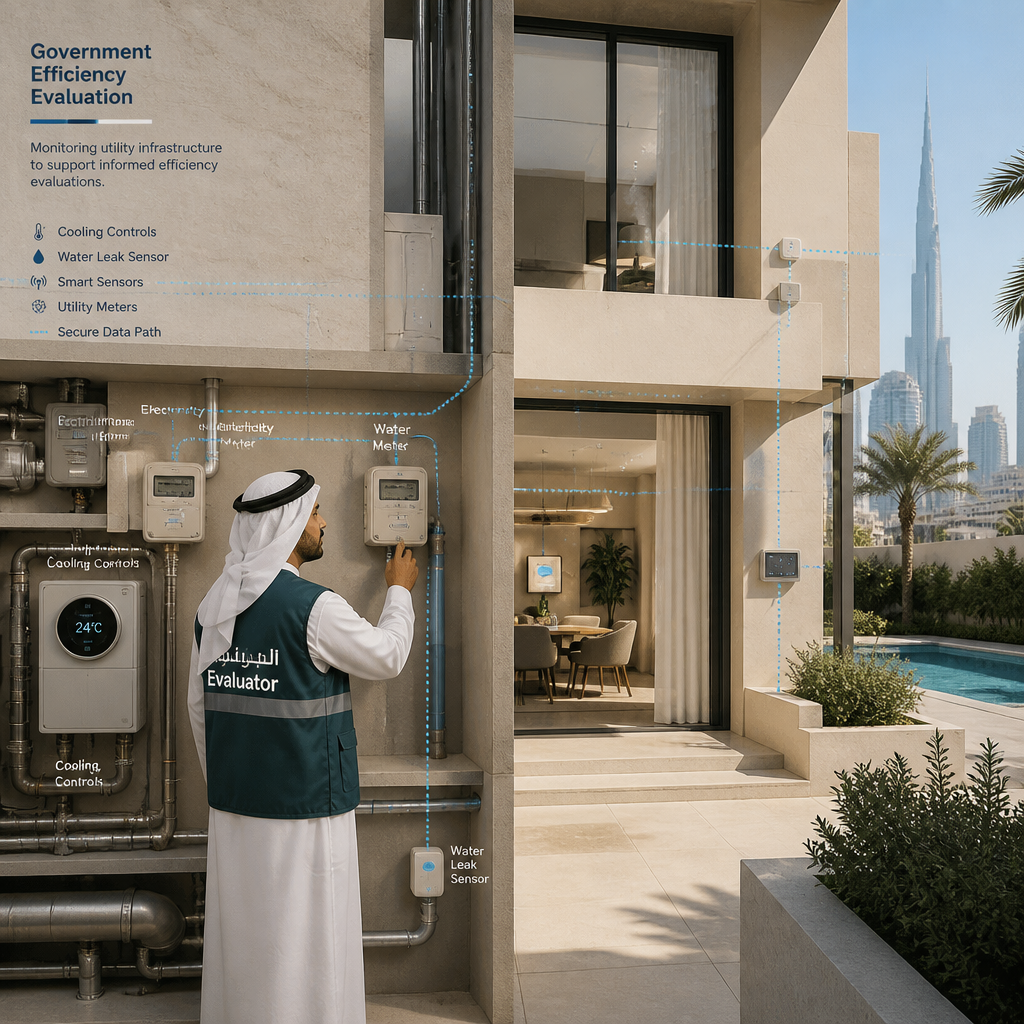
For government teams exploring “dewa savings from smart” homes, the useful question is not how many devices a property can connect. It is whether a proposed control strategy can demonstrate reduced resource use without compromising comfort, accessibility or accountability. Treat savings as a hypothesis to test, not a feature to purchase. This guide sets out an evaluation approach rather than a savings forecast.
Separate smart-home interest from savings evidence
The supplied Khaleej Times extract frames UAE smart-home adoption through voice interactions and connected living, rather than a documented household energy evaluation.[narrative_en_dewa-savings-from-smart] That distinction should shape the entire discussion. Activity on a connected platform is not, by itself, proof that a household has avoided electricity or water consumption.
For this assessment, the supplied material does not establish a verified savings rate, a household payback period or a applicable tariff calculation.[narrative_en_dewa-savings-from-smart] Those gaps should remain visible rather than being filled with generic market estimates.
A government-facing brief should therefore distinguish what is proposed, what has been observed and what remains uncertain. Ask suppliers to describe the resource-saving mechanism behind each automation. If the explanation ends at convenience, remote access or voice control, classify the proposal as a convenience feature until an appropriate measurement exercise supports an efficiency claim.
Define what the project intends to change
Start with an operational objective, not a device catalogue. A useful brief might ask a proposed system to identify unnecessary operation, flag unusual consumption or let residents manage schedules without specialist support. Present these as intended outcomes, not assured results.
Specify the household activities and equipment within scope. Also identify what is outside the project: shared services, landlord-controlled equipment or charges that the proposed system cannot influence. Do not describe an entire bill as addressable without checking that boundary.
For an initial discussion, use the smart-home planning page to frame questions about the intended living environment. Keep the resulting requirements independent of product preferences. The procurement question should remain: what behaviour will change, who can authorise that change, and how will the project determine whether it helped?
Build a baseline that can support a fair comparison
Before changing controls, document the existing operating pattern. Request suitable consumption records, note occupancy arrangements and record relevant equipment settings. Choose a baseline period that reflects the conditions the project expects to evaluate, and explain any gaps in the available data.
Plan how the assessment will handle weather, absences, equipment replacement and changes in household routines. Do not attribute every movement in a bill to automation. Require the evaluator to explain alternative causes and state where the evidence cannot separate them.
Keep the original records alongside the analysis. A reviewer should be able to trace an asserted improvement back to the underlying observations. If the baseline is incomplete, label findings provisional and consider extending observation rather than converting uncertainty into a confident savings claim.
Assess control strategies without promising outcomes
Consider proposed cooling schedules, lighting controls and water alerts as distinct interventions. For each, ask what triggers an action, what equipment responds and what evidence would show that the action was useful. Avoid bundling every connected feature into an undifferentiated efficiency package.
A proposed cooling routine, for example, should explain how occupancy information is interpreted and how a resident can override an unsuitable setting. A lighting routine should define the conditions under which a space is considered unused. A water alert should specify who receives it and who is responsible for investigating.
These are design questions, not demonstrated savings claims. Require a commissioning test for each intended behaviour, followed by observation in ordinary use. Record failed triggers, unnecessary alerts and manual overrides as part of the evaluation, not as inconvenient exceptions.
Treat comfort and resident agency as acceptance criteria
Do not judge an intervention successful solely because a consumption figure falls. Ask whether the home remained suitable for its occupants and whether the controls were understandable. Define acceptable conditions with the people who will live with the system rather than relying only on an installation specification.
Require accessible manual controls and a clear way to pause an automation. Plan what should happen when connectivity is unavailable, a sensor provides an implausible reading or a resident changes their routine. Include these situations in acceptance testing.
Invite residents to report discomfort and confusing behaviour without treating every override as misuse. Review that feedback alongside consumption records. The desired outcome is a workable operating approach, not a nominal efficiency result that depends on occupants tolerating settings they would otherwise reject.
Make monitoring proportionate and accountable
Design the measurement plan around the question being tested. Ask whether aggregate readings would answer it before requesting detailed household activity records. Specify the purpose of each data field, the people permitted to access it and the proposed retention arrangements.
For procurement, request a clear description of data export, account ownership and access removal. Establish who will maintain the controls after handover and who will investigate missing readings. Treat an attractive dashboard as a presentation tool, not a substitute for accessible underlying evidence.
The open smart-home ecosystem page can serve as a starting point for questions about integration and handover. Independently verify any proposed compatibility. Put the required interfaces, operating responsibilities and exit arrangements into the project brief rather than assuming them from a general description.
Translate measured consumption into costs carefully
Keep resource accounting separate from financial accounting. First establish what consumption changed within the agreed boundary. Then calculate the associated cost effect using the billing information applicable to the evaluated household and period. Make the calculation available for review.
Do not insert an assumed tariff, ignore unrelated charges or present a supplier's forecast as an observed bill reduction. Ask for a transparent distinction between installation expenditure, ongoing operating costs and the value assigned to any measured consumption change.
If a proposal includes payback, request its assumptions and test how the conclusion behaves when those assumptions change. Where the evidence is insufficient, say that payback remains unverified. This article intentionally offers no percentage reduction or financial estimate; the supplied evidence does not establish either.[narrative_en_dewa-savings-from-smart]
Use a pilot to decide what deserves expansion
Write the decision criteria before the pilot begins. Define what would justify continuing, changing the design or stopping. Include consumption evidence, resident feedback, maintenance demands and data quality rather than relying on a headline savings figure alone.
Choose pilot homes to reflect the situations the intended programme must address, and describe the limits of that selection. Avoid extending a favourable result to properties with different equipment, occupancy patterns or operating responsibilities without further assessment.
The final report should connect each conclusion to its evidence and explain unresolved uncertainty. A credible outcome may be a narrower deployment, revised controls or a decision not to proceed. For government teams, the aim should be a defensible allocation of resources—not confirmation that every smart-home intervention must deliver savings.
The responsible approach to smart-home savings is to define the intervention, test it under realistic conditions and report uncertainty openly. Government buyers should ask for traceable evidence, usable controls and clear operating responsibilities before considering wider deployment. Connected functionality is a proposal; demonstrated value is an evaluation outcome.
Frequently asked questions
What savings percentage should a government brief assume?
Do not assume a percentage from the supplied material; it does not establish a verified household savings rate.[narrative_en_dewa-savings-from-smart] Request project-specific evidence and label any forecast clearly.
What should be measured before installation?
Document consumption, occupancy arrangements, equipment settings and the billing boundary. Agree how the evaluation will address weather, household routine changes and missing records.
Should voice-control usage count as evidence of savings?
Do not use interaction volume as the project's efficiency acceptance test. Require evidence connecting the proposed control strategy to a measured consumption outcome.
Explore next
Get a tailored Smart Citizens proposal
Tell us about your villa, apartment or project — our AI Advisor recommends the right package within minutes, or book a free site visit with our Dubai team.
Prices and recommendations may vary based on villa size, wiring, system type, and customer requirements.
Share this guide with someone planning a smart home in Dubai.